News
Bankruptcy debt limits expanded under new federal law.
For cases filed on or after November 10, 2026, Chapter 13 has one combined debt limit, and more small businesses may qualify for Subchapter V.
The new law
The Bankruptcy Threshold Adjustment Act was signed into law on November 10, 2026, expanding access to two bankruptcy options: Subchapter V for qualifying small businesses and Chapter 13 for individuals with regular income. The new limits apply to cases filed on or after that date.
The changes focus on debt limits: the maximum amount of debt a person or business may have and still qualify for a particular type of bankruptcy.
Chapter 13 now has one combined debt limit
The law changes eligibility for Chapter 13, which allows an individual with regular income to propose a court-approved repayment plan.
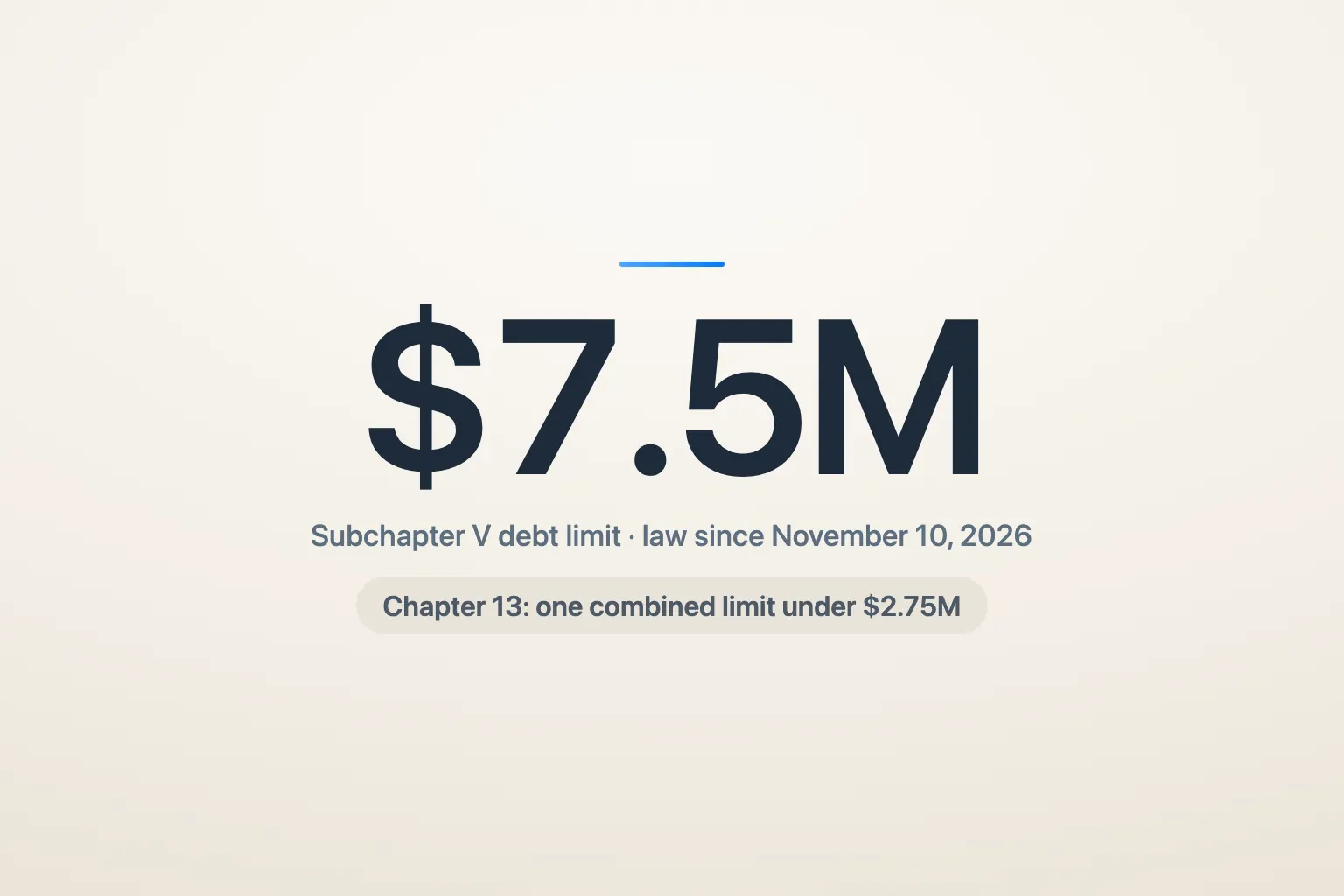
Previously, Chapter 13 eligibility treated secured and unsecured debts separately, with limits of $1,580,125 in secured debt and $526,700 in unsecured debt. The new law replaces that approach with a single combined limit. An individual may qualify if the person's noncontingent, liquidated debts total less than $2.75 million on the filing date, without a separate eligibility limit for secured and unsecured debt.
In practical terms, this simplifies the initial debt-limit calculation. Instead of fitting within two different categories, a person's noncontingent, liquidated debts are counted together.
More small businesses may qualify for Subchapter V
The new law restores the Subchapter V debt limit to $7.5 million, with no expiration date. Before this law, the limit was $3,424,000. A qualifying business with no more than $7.5 million in noncontingent, liquidated secured and unsecured debt, not counting debts owed to affiliates or insiders, may seek relief under Subchapter V.
Subchapter V is part of Chapter 11 designed for qualifying small-business debtors. Raising the limit means that more financially distressed businesses may be able to use this option rather than proceed under a traditional Chapter 11 case.
Eligibility still depends on more than the amount owed. The debtor must satisfy the other requirements that apply to Subchapter V cases.
Why these changes matter
Debt limits can determine which bankruptcy chapter is available before a case even begins. A business or individual who exceeds the applicable limit may need to consider another form of bankruptcy, which can involve different procedures, costs, and requirements.
By increasing and simplifying the limits, the new law makes Subchapter V and Chapter 13 available to a broader group of debtors. The changes do not guarantee that either option is appropriate in every situation, but they may give more businesses and individuals access to a structured process for addressing debt.
Sources & further reading
- GovInfo: H.R. 7730, Bankruptcy Threshold Adjustment Act, enrolled bill text
- The White House: H.R. 997, H.R. 1703, H.R. 1945, and H.R. 7730 signed into law (November 10, 2026)
- Congress.gov: H.R. 7730, all actions
- Federal Register: Revision of Certain Dollar Amounts in the Bankruptcy Code (February 4, 2025)
General information, not advice about your circumstances. Read the original sources for their full definitions and context. Statistics describe the stated period, not a personal outcome.